
Georgia Just Doubled Its Homestead Exemption. Here’s What It Means When You’re the Creditor.

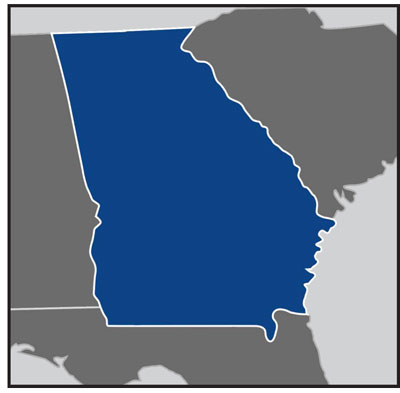
If you make loans to members in Georgia or have members who live in Georgia, a change is coming on July 1, 2026, that is worth your attention. On May 11, 2026, Governor Kemp signed House Bill 1024 into law, which more than doubles the amount of home equity a debtor can shield from creditors in Georgia.
The old numbers had been on the books for years: an individual could protect $21,500.00 of equity in a primary residence, and a married couple, who jointly owned the home, could protect $43,000.00. Under HB 1024, those figures jump to $50,000 for an individual and $100,000 for a married couple. And the increases do not stop there — beginning July 1, 2031, both amounts will be adjusted upward for inflation each year. In other words, the floor just rose sharply, and it is designed to keep rising.
Most of the coverage you’ll see on this law is written for homeowners and debtors, framing it as good news. For credit unions, it is a different conversation.
 First, the distinction that matters most: secured vs. unsecured
Georgia’s homestead exemption has never touched a consensual lien, and HB 1024 does not change that. If your credit union holds a properly recorded security deed on a member’s home, your foreclosure rights are completely unaffected. The same goes for a purchase-money mortgage. The exemption protects equity from unsecured creditors — it does not let a borrower wipe out the loan they voluntarily pledged the house to secure.
So where does this law impact a credit union? On the unsecured side of your book. Think signature loans, lines of credit, credit card balances, overdraft, and deficiency balances. When you reduce that kind of debt to a judgment and look for assets to satisfy it, the member’s home equity was once a realistic target. After July 1, 2026, a lot more of that equity is simply off the table.
In bankruptcy: less to collect and your judgment liens are more exposed
Georgia is an “opt-out” state, which means a debtor who files for bankruptcy here must use Georgia’s exemptions rather than the federal set. As a result, the new $50,000.00/$100,000.00 figures apply directly in every Georgia bankruptcy filed on or after the effective date.
The first effect is straightforward: a Chapter 7 trustee can only reach the non-exempt equity in a home. Raise the exemption, you shrink that pool. Plenty of homes that would have produced a distribution to unsecured creditors under the old cap will now be fully protected, and the case will close with nothing for the unsecured pool. In Chapter 13, the same logic applies to the “best interest of creditors” test – if the hypothetical Chapter 7 recovery is lower, the minimum a plan must pay unsecured creditors can drop right along with it.
The second effect is the one that catches creditors off guard. The Bankruptcy Code lets a debtor avoid a judicial lien (like a recorded judgment lien) to the extent it impairs an exemption the debtor is entitled to claim (that’s the tool at 11 U.S.C. § 522(f)). With the exemption now more than double its old size, far more judgment liens will “impair” the homestead and be subject to being stripped off. And here’s the part to underline: the exemption a debtor gets to claim is generally the one on the books when they file. A judgment lien you recorded back when the exemption was $21,500.00 is not grandfathered at that level. If the member files after July 1, 2026, your old lien is measured against the new, larger exemption — and may well be avoidable. The “record a judgment and wait for the equity to build” strategy just got a lot less reliable.
In state court: levying on the home gets you less
Outside of bankruptcy, the practical math shifts in the same direction. When your credit union holds an unsecured judgment and looks to the member’s residence to satisfy it, the homestead exemption is exactly what shields the equity from levy. Doubling the protected amount means that for a large share of Georgia homeowners, there’s now little or no exposed equity left to reach. A levy that once promised a meaningful recovery may now barely clear the costs of pursuing it.
This doesn’t make recording a judgment pointless—a properly recorded Fi.Fa. still creates a lien on the debtor’s real property and can capture genuinely non-exempt equity. But it does mean two things. First, you should expect to recover against fewer homes and smaller slices of equity. Second, as noted above, any lien you’re sitting on is now far more vulnerable if the member ever files (Georgia’s exemption-against-levy mechanics have their own wrinkles, so for a specific file we are happy to walk through any fact pattern with you).
What didn’t change
A few things stayed put, and they’re worth keeping in mind
- Consensual liens are untouched. Your security deeds and purchase-money positions are as strong as ever.
- The usual carve-outs survive. The homestead exemption still won’t stop a security-deed foreclosure, a tax lien, or a domestic-support obligation.
- The “wildcard” cap held. HB 1024 amended only the homestead paragraph. The separate provision that lets a debtor apply unused homestead to other property is still capped at $10,000.00 – so the bigger homestead doesn’t translate into bigger protection for cars, cash, or other personal property.
The bottom line for credit unions
- Lean on your collateral. This law is a reminder that your real protection comes from a perfected, consensual lien, not from the hope of chasing home equity after the fact. For larger consumer loans and member-business credit, securing the loan on the front end matters more than ever.
- Re-value your unsecured recovery prospects. If your collection and charge-off models assume you can reach a Georgia member’s home equity to satisfy a deficiency or signature-loan judgment, those assumptions need a refresh as of July 1, 2026.
- Don’t assume old liens are safe. A judgment lien recorded before the increase is still exposed to the new exemption in a later filing. Factor that into how you value and pursue existing judgments.
- Reset your workout posture. Members with homes now hold more leverage in settlement talks, because your fallback (reaching their equity) is weaker. Pricing that into negotiations early can lead to better, faster resolutions.
If it would help to look at how HB 1024 touches a specific portfolio, judgment, or pending matter, reach out—we are glad to dig into the particulars with your team.
CFPB Revises Section 1071 of the Dodd-Frank Act

In response to the 2008 Financial Crisis, Congress passed the Dodd-Frank Wall Street Reform and Consumer Protection Act (“Dodd-Frank Act”). The law was signed by President Barack Obama in 2010 with the following primary directives: (1) promote financial stability, (2) prevent taxpayer-funded bailouts, and (3) protect consumers from abusive financial practices
. Naturally, the Dodd-Frank Act encompassed a vast amount of territory. In addition to its directives, it created the Consumer Financial Protection Bureau (“CFPB”). The CFPB promulgates and enforces rules for financial institutions, including Credit Unions. One of the areas that Congress instructed the CFPB to monitor in the Dodd-Frank Act was small business lending.
Congress has expressed interest in credit availability for small businesses, as a means to stimulate the economy and create jobs. Specifically, Section 1071 of the Dodd-Frank Act “amended the Equal Credit Opportunity Act (ECOA) to require financial institutions to compile, maintain, and submit to the Bureau certain data on applications for credit for women-owned, minority-owned, and small businesses,” according to the CFPB’s website.
Thus, Section 1071 of the Dodd-Frank Act requires the CFPB to “collect data from lenders concerning loan applications made by small businesses with the goals of better understanding the financing needs of those owned by women and minorities and identifying possible discrimination,” according to congress.gov.
This directive required financial institutions to (1) inquire whether a business is women-owned, minority-owned, or a small business and (2) maintain a record of responses to the inquiry, when the financial institution received an application for credit from a women-owned, minority-owned, or a small business.
The original directive required financial institutions that made as few as 100 credit originations per year to comply with the above. However, the CFPB recently released a revised Section 1071, which increased that number to 1,000 credit originations per year. This means that Credit Unions with 1,000 covered transactions in each of the previous two years are covered under this revised rule and must comply.
The revised rule made additional changes. First, it changed the definition of small business. Under the original rule, a small business was defined as a business that made $5 million in gross annual revenue. The revised rule decreased that amount to $1 million.
Second, the revised rule now excludes the following types of loans from the reporting requirement: (1) Merchant Cash Advances, (2) Agricultural Lending, and (3) Small dollar credit (loans less than $1,000.00).
Finally, the revised rule reduced the number of data points for collection. The revised rule eliminated the following data points: (1) application method, (2) application recipient, (3) denial reasons, (4) pricing information, and (5) number of workers, among other items.
The compliance date for the revised rule is January 1, 2028. Financial institutions must begin collecting twelve months of data at that point for submission on June 1, 2029.
The revised rule streamlines the collection and reporting requirements for financial institutions, including Credit Unions. Please reach out to an attorney at SVL for compliance questions and assistance.
Staff Spotlight on Trace Wells

Traci was born in Atlanta, Georgia. She moved to Clearwater, Florida, when she was nine years old. She lived in the Tampa Bay area for most of her life before moving to Tallahassee two years ago. She had visited Tallahassee many times in her childhood because her mom’s sister and cousins lived here – she knew it would be a great town to end up in. Traci has two daughters who still live in the Tampa Bay area; Emily (22 years old) and Elisabeth (16 years old). Emily is a graphic designer and Elisabeth will be starting her junior year in high school this August.
Traci joined our firm in September 2025 and is a legal clerk who handles recording and certifying final judgments. Traci also assists the post-judgment department with several tasks as well. During her spare time, Traci loves arts and crafts, music, boating, and the beach. She also likes to garden and has a passion for health and wellness; Traci has volunteered with a health food co-op for many years and became a certified fitness trainer/nutrition coach. Traci also enjoys being involved with her local church and helping the community when she is able.
Traci, thank you so much for your hard work at SVL. We look forward to many more years with you
Staff Spotlight on Lilly Pollard

Lilly is originally from Fort Wayne, Indiana. She moved to Largo, Florida, when she was six years old. She grew up with two brothers and is the middle child in her family. Lilly was a competitive cheerleader, played indoor and outdoor volleyball, flag football, and basketball in school. She was also a synchronized swimmer for four and a half years.
Lilly graduated from Florida State University in 2024 with her Bachelor’s in history and a minor in Humanities, specializing in Classics and English. The ancient world and the Renaissance fascinate her! On Lilly’s bucket list are trips to Greece and Italy! Currently, Lilly is working towards her master’s in law from Northeastern University in Public Policy.
Lilly has been a part of the SVL team since June 2025. She is one of the legal assistants in our bankruptcy department. Away from the office, Lilly enjoys reading and spending time with her cat, Louie. She is also a big movie buff (especially 80s movies) and enjoys musicals and trivia too. A weekly must for Lilly is going line dancing with her friends.
Lilly, thank you for being such a dedicated team player for the firm. We appreciate you!
2026 CUCP Summit
The 2026 CUCP Collections Summit was held in Tampa, Florida, on May 12-14, 2026, and Sorenson Van Leuven had the opportunity to be a gold sponsor for the event. This three-day conference delivers training and provides networking opportunities with other collection professionals. It was great connecting with everyone, and we look forward to next year.

ENGAGE Conference 2026
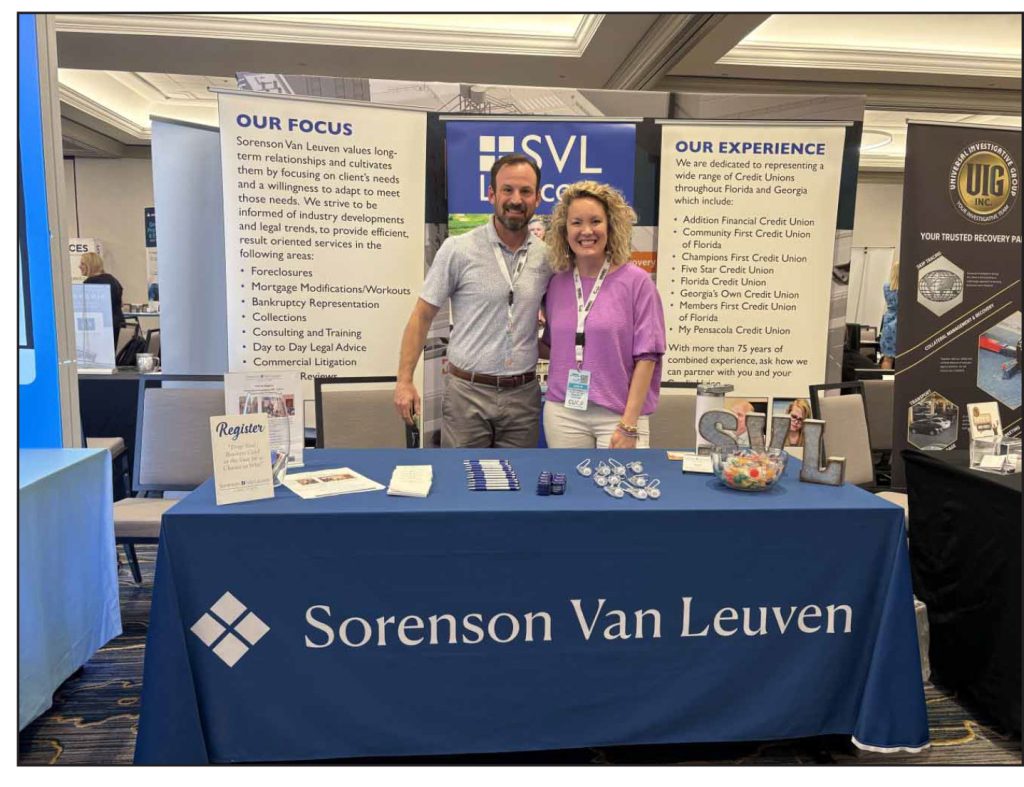
Our firm attended the ENGAGE Conference in Orlando, Florida, on June 10-12, 2026. The ENGAGE Conference is an annual event we do not miss and one we look forward to each year. We enjoy having the chance to visit with our Credit Union clients and the opportunity to host a booth inside the exhibit hall. ENGAGE is hosted by The League of Credit Unions & Affiliates and features expert speakers and breakout sessions for leaders across Alabama, Florida, Georgia, and Virginia.



The Storm Is Building: What Rising Foreclosures and Bankruptcies Mean for Your Credit Union
and Lost Leverage
If you’ve been watching the economic headlines lately, you’ve probably noticed some unsettling trends. Foreclosure filings are climbing. Bankruptcy filings are climbing faster. And with inflation still squeezing household budgets and energy prices on the rise, there’s a real possibility that things get worse before they get better. As your credit union’s trusted legal resource, we want to make sure you’re seeing what we’re seeing — and that you’re ready for what may be coming.
The Numbers Don’t Lie
Let’s start with foreclosures. According to ATTOM’s most recent data, there were 42,430 properties nationwide with foreclosure filings in April 2026 alone — an 18% increase compared to April 2025. Zoom out a bit further, and the first quarter of 2026 shows 118,727 properties with foreclosure filings, up 26% year over year. Completed foreclosures — homes actually taken back by lenders — surged 42% annually in April. These aren’t rounding errors. This is a clear and consistent upward trend.
On the bankruptcy side, the U.S. Courts reported that total bankruptcy filings hit 574,314 in the twelve months ending December 2025, an 11% jump from the prior year. Both business filings and personal (non-business) filings increased, with personal bankruptcies — the kind your members are most likely to file — rising 11.2% to nearly 550,000 cases.
Why It Could Get Worse
Here’s what makes us more concerned: these numbers reflect conditions before the full impact of recent economic headwinds. Inflation has kept household budgets stretched thin, and rising oil and gas prices are adding pressure on top of that — both directly (at the pump and on utility bills) and indirectly (as higher energy costs ripple through the prices of groceries, goods, and services). When people are choosing between filling the gas tank and making a loan payment, the loan often loses.
We expect these economic pressures to continue driving both foreclosure and bankruptcy numbers higher in the months ahead. Credit unions — which tend to be deeply embedded in the communities they serve — will feel this directly in their collection pipelines, loss-mitigation queues, and member relationships.
What This Means for Your Credit Union
This is a moment that rewards preparation. Here’s what we’d encourage you to think about right now:
Review your collections policies and procedures. When was the last time your collections playbook got a serious look? Regulations change, best practices evolve, and what worked three years ago may expose you to compliance risk today — especially as litigation over improper collection practices remains active.
Audit your foreclosure processes. From the notice requirements to timelines to post-foreclosure handling, there are many moving pieces in a foreclosure — and several places where errors can lead to liability or losses. If your team hasn’t walked through that process recently, now is a good time.
Invest in training. Your frontline collections staff, loan officers, and management teams are going to encounter more distressed members in the coming months. Are they equipped to handle those conversations correctly — legally, operationally, and in a way that reflects your credit union’s values? Training now is far less costly than litigation later.
We’re Here to Help
We work with credit unions every day on exactly these issues — from reviewing policies and procedures to providing practical training for collections teams and loan officers. If you’d like a fresh set of eyes on your processes, or if you want to get your team up to speed on what to expect (and how to handle it) as bankruptcies and foreclosures increase, we’d love to talk.
Don’t wait for the storm to arrive. Reach out to us today, and let’s make sure your credit union is ready.
Jim Sorenson |Sorenson Van Leuven, PLLC | |jim@svllaw.com
This blog post is for informational purposes only and does not constitute legal advice. For guidance specific to your credit union’s situation, please contact us directly.

When Bankruptcy is Mentioned: Avoiding Premature Releases
and Lost Leverage

Credit Unions frequently hear borrowers reference “bankruptcy” in ways that are incomplete, vague, or strategically timed. These statements often cause collection files to stall while staff try to determine whether collections must stop. They may appear in handwritten Answers, emails, text messages, or statements such as “this was in my bankruptcy,” or “I filed before,” with no supporting information or general hardship statements framed as bankruptcy.
\While caution is appropriate, paralysis is not. The critical distinction is simple: mentioning bankruptcy is not the same as filing bankruptcy. Even when the petition has been filed, timing determines what actually changes. Understanding procedural posture allows creditors to avoid stay violations without surrendering rights that bankruptcy law does not eliminate.
A bankruptcy reference is not a bankruptcy filing.
Informal references do not trigger the stay. The automatic stay arises only upon the filing of a bankruptcy petition. 11 U.S.C. § 362(a). Until that moment, there is no stay in effect. Courts do not require creditors to assume a bankruptcy exists based on unsupported statements. The proper response is verification, not suspension of the file.
For example, a borrower may file an Answer, stating that the debt “was included in bankruptcy,” yet provide no case number, court, or filing date. Without confirmation that a petition has actually been filed, that statement alone does not establish that the automatic stay is in effect. Of course, once a bankruptcy filing is confirmed, any continued collections activity must stop immediately to avoid violating the automatic stay.
Creditors can verify whether a bankruptcy case has actually been filed by searching the federal court system through PACER (Public Access to Court Electronic Records) at https://pacer.uscourts.gov/. PACER provides nationwide access to bankruptcy filings, though users must first create an account to conduct searches. If a filing cannot be confirmed or additional guidance is needed, creditors may also contact our office to assist in verifying whether a bankruptcy case exists and determining the appropriate next steps.
Claim classification turns on origination, not default.
Another frequent misunderstanding is the belief that repossession, sale, or calculation of a deficiency creates a new post-bankruptcy debt. Bankruptcy law does not operate that way. A “claim” arises when a loan obligation is incurred, not when the borrower defaults or collateral is sold. 11 U.S.C. § 101(5). An obligation arising before the bankruptcy filing constitutes a pre-petition claim, even if the right to payment is contingent or unmatured at the time of filing, and later repossession or deficiency calculations do not convert that obligation into a post-petition claim. This timing distinction matters when defendants rely on vague references rather than confirmed filings.
Pre-judgment v. Post-judgment: Two different analyses.
Before judgment, the question is straightforward:
- If no petition has been filed, litigation may proceed.
- of a petition has been filed, the automatic stay applies to pre-petition claims.
After judgment, the analysis changes. The focus shifts from the existence of the debt to enforcement of that judgment. A bankruptcy filing does not retroactively invalidate a judgment entered before the petition date. A subsequent discharge eliminates only the debtor’s personal liability and therefore limits how the judgment may be enforced. As the Supreme Court explained in Johnson v. Home State Bank, 501 U.S. 78 (1991), a discharge eliminates personal liability but does not automatically eliminate valid liens. This distinction is where many files freeze unnecessarily.
Discharge does not equal lien elimination.
A discharge under 11 U.S.C. § 524(a) bars collection against the borrower personally. It does not automatically remove the liens attached before the bankruptcy filing. Lawyers describe surviving lien rights as “in rem” rights. These are rights against the property itself rather than the borrower. A lien is removed only if the debtor obtains a specific bankruptcy court order avoiding it, most commonly under 11 U.S.C. § 522(f). Without such an order, the lien remains. Treating discharge as synonymous with lien removal leads to premature releases and lost leverage.
Chapter 7 v. Chapter 13: Why collection files freeze (and when they shouldn’t).
|
Issue
|
Chapter 7
|
Chapter 13
|
| Core structure |
Liquidation and discharge of personal liability |
Court-approved repayment plan |
| Automatic stay |
Stops new collection activity while the case is pending |
Stops enforcement while the plan is pending |
| Effect on judgment |
Judgment remains legally valid |
Judgment remains legally valid |
| Effect on pre-petition lien |
Survives unless the debtor obtains a lien-avoidance order |
May be addressed in the plan but it is not automatically removed |
| When enforcement resumes |
After a stay relief, dismissal, or case closure |
After stay relief, dismissal, or plan completion |
| Common mistake |
“Discharge means the lien disappeared.” |
“The plan invalidated the judgment.” |
Florida and Georgia: same practical rule.
Bankruptcy law is federal; lien mechanics are state-specific. In Florida, a hybrid system is used: judgment liens on personal property arise through a statewide registry, while real property liens depend on county recording. Georgia relies primarily on county recording, where filing a writ of fieri facias (Fi. Fa.) creates a real property lien in the county of record.
Despite the different terminology, the result is the same in both states: a properly recorded pre-petition lien survives discharge unless affirmatively avoided in the bankruptcy court. Discharge alone does not determine whether a lien must be released.
Verification Framework
When bankruptcy is mentioned, ask:
- Was a petition actually filed?
- What is the filing date?
- Has the judgment already been entered?
- Was a lien recorded before the petition date?
- Did the bankruptcy court enter an order avoiding that lien?
Verification should precede suspension of the file. Internal preparation may continue and deadlines preserved. Enforcement should pause only if a petition is confirmed.
Summary
- Informal bankruptcy references do not trigger the automatic stay.
- Claims arise at loan origination, not at default or repossession.
- Discharge bars personal collection, not necessarily property rights.
- Pre-petition liens survive unless affirmatively avoided.
- Timing determines authority.
Bankruptcy is not a universal stop sign. It is a timing-based legal framework: confirm first, pause after.
If you have questions regarding the impact of bankruptcy on a collections matter or judgment enforcement, please contact a lawyer at our office. We would be happy to discuss your situation.
Rising Auto Loan Delinquencies: Repossession and Deficiency Issues for Credit Unions in Florida and Georgia

Auto lending remains one of the largest asset categories for most Credit Unions, particularly in Florida and Georgia. As economic pressures continue, as the price of vehicles continues to grow, and as interest rates are elevated, many institutions are beginning to see increased delinquencies and repossessions in their auto portfolios. While both Florida and Georgia follow Article 9 of the Uniform Commercial Code (UCC), governing secured transactions, there are important differences in repossession procedures, notices, and deficiency recovery that Credit Unions must understand.
Both Florida and Georgia allow creditors to repossess vehicles after default, without judicial process, provided the repossession occurs without a breach of the peace. That being said, Credit Unions need to keep in mind some key considerations, such as:
- Using licensed repossession agents;
- Avoiding confrontations with borrowers during repossession;
- Proper handling and storage of borrower personal property; and
- Maintaining documentation of the repossession process.
While there are many similarities in the laws governing Florida and Georgia, there are also some differences, and the practical litigation environment differs between the two states. Improper repossession can expose lenders to claims for conversion, wrongful repossession, or consumer protection violations.
In Florida, deficiency actions following repossession are common but must strictly comply with the notice requirements under Florida Statutes, Chapter 679. Important considerations include sending a compliant Notice of Disposition of Collateral after Repossession; an Explanation of Deficiency/Surplus, if necessary; and conducting the sale in a commercially reasonable manner. Florida courts closely scrutinize the sufficiency of notices. Defective notices can limit or eliminate the ability to recover a deficiency balance or possibly lead to a class action lawsuit with serious liability. Additionally, Florida’s consumer litigation environment often leads to borrower challenges regarding a breach of the peace during repossession, failure to provide proper post-repossession notices, and the commercial reasonableness of vehicle sales.
In Georgia, O.C.G.A. § 11-9-601 through 11-9-628 governs repossession and collateral disposition. Georgia courts have historically been particularly strict regarding the commercially reasonableness of the sale, timing of the Notices, and type of Notice sent. For instance, the Notice of Plan to Sell letter must be sent within 10 days of the repossession and failure to do so is detrimental to any possible deficiency action. It also matters what type of letter is sent. If the contract is a Retail Installment Sale Contract, then Georgia law requires a special “right to redeem and public sale notice,” which most Florida-based Credit Unions do not have. The additional provision is as follows:
Under the law, you have a right to redeem or demand a public sale of the above-described collateral. This must be requested in writing from you and sent by registered or certified mail or statutory overnight delivery addressed to us within ten (10) days of the date of this letter. Proceeds will be applied as previously stated in this letter.
Again, this special notice is only required when the contract is a Retail Installment Contract and the collateral is a motor vehicle. This language would not be required when using the Credit Union’s own loan documents.
As delinquency levels rise, Credit Unions that maintain well-documented repossession procedures and state-specific compliance practices will be better positioned to recover losses while minimizing legal risk. I would recommend that your Credit Union consider reviewing its repossession vendor agreements annually, updating repossession and disposition notice templates, documenting collateral sale procedures, and evaluating deficiency recovery strategies. Understanding the nuances of each state’s repossession and deficiency framework is essential to protecting lien rights and maintaining effective collection strategies. If you have questions or if we can be of help, please reach out to a lawyer at our firm.
Staff Spotlight on Noel Harlan

Noel is originally from Chicago, Illinois. She moved to Florida for college where she attended Florida Agricultural & Mechanical University (FAMU) in the spring of 2025. She graduated with a bachelor’s degree in political science. While in college, Noel met her now husband Trevor at Chick-fil-A where they were both were employed. They dated for two and a half years and got married on November 14, 2025. During the holidays, Trevor and Noel located an 11-week-old Basset Hound mix off Facebook and brought him home. The pup’s name is Todd and Noel says he loves cookies and playing a rough game of tug o’ war.
Noel is one of our legal assistants in the collections department and has been a part of the SVL team since April 2025. She mentioned that what she likes most about working at the firm is the kindness that the staff here share with one another. This is a perspective that we love to hear!
Away from the office, Noel likes going for runs in her neighborhood or at a local park here in Tallahassee called Cascades. She also enjoys cooking and doing strength training. Noel began cooking at the age of 4 and loved cooking pizzas as a young chef. Now cooking a basic steak dinner with different yummy sides is her go-to meal. One more fun fact about Noel is that she is a travel agent. Her love for traveling came from her grandmother who is also an agent. Noel has been an avid traveler since the age of 12 and her most treasured trip was to China – she says the education behind the tours, the beautiful gardens, and the food were amazing!
We are grateful to have you here at SVL, Noel.
Staff Spotlight on Alejandra Fernandez

Ale is originally from Toluca, Mexico, but she now resides in Guadalajara, Mexico. Ale often visits her extended family in her hometown. Ale has two daughters, Giovanna, who is 21 years old and Nikita, who is 17 years old. Giovanna is fashion design student. She has earned recognition on local television in Mexico! Nikita is in high school. She excels in academics and flag football. Ale has a strong connection to her heritage and feels she brings this strong sense of family values to our SVL team.
Ale has been a part of our firm since April 2025. She takes immense pride in her role as a collections legal assistant. Away from the office, Ale spends most of her time centered around her daughters and their various activities. She also enjoys cooking and learning new culinary skills. Ale’s specialty and favorite dish to cook is pork tacos. Ale would love to learn how to make homemade tortillas from scratch and hopes to learn that next! On the weekends, Ale and her friends have a tradition to engage in weekly card game of Phase 10. Ana, another collections legal assistant from our office usually wins!
Ale, we are grateful for you and the values you bring to our team.


 In a recent decision from the United States District Court for the Southern District of New York, the court addressed a growing issue for businesses using generative artificial intelligence. In United States v. Heppner (Feb. 17, 2026), the court held that written exchanges between a defendant and an AI platform were not protected by the attorney-client privilege or the work product doctrine.
The defendant had used an AI tool to prepare written analyses of his legal strategy and later claimed those communications were privileged. The court rejected that argument. It emphasized that communications with an AI platform are not communications with a lawyer, and that sharing sensitive information with a third-party platform—particularly one that may collect, retain, or disclose user data—undermines any expectation of confidentiality. The court also found that documents generated independently by a user, without direction from counsel, were not protected work product.
For credit unions, the takeaway is clear: generative AI is a powerful tool, but it is not a lawyer, and it is not automatically covered by traditional privilege doctrines. The legal framework governing AI continues to evolve, and courts may scrutinize how AI tools are used in connection with sensitive matters.
Before entering confidential member information, examination findings, litigation strategy, or other sensitive data into an AI platform, consult counsel. The convenience of AI should never come at the expense of privilege or regulatory compliance.
Should you have questions about the use of AI or developing a policy for the use of AI, please do not hesitate to contact our firm.

New Debt Collection Legislation

In May of this year, Governor Ron DeSantis signed into law Senate Bill 232, which made some changes to the Florida Consumer Collections Practices Act (FCCPA). These changes cut off claims for relief for consumers and consumer protection law firms with respect to email communications. Due to the rising number of lawsuits that allege debt collectors have violated the “quiet hours,” outlined in the statute, specifically via emails sent after 9:00 p.m. or before 8:00 a.m. in the consumer’s local time zone, the amendment to the FCCPA clarifies that prohibited contact between the hours of 9:00 p.m. and 8:00 a.m. in debt collection does not include email communication. The revised section of the FCCPA (Fla. Stat. § 559.72(17)) now states that a creditor is prohibited to “communicate with the debtor between the hours of 9:00 p.m. and 8:00 a.m. in the debtor’s time zone without the prior consent of the debtor. This subsection does not apply to an email communication that is sent to an email address and that otherwise complies with this section” (emphasis added).
 In commentary surrounding the bill, the Florida Legislature “acknowledges that Florida Statute § 559.72 was adopted before email communication became commonly used, and that the only specific communication explicitly contemplated in such subsection is telephone calls.” Senate Bill 232 sought to “update and clarify prohibited practices in collecting debt to address email communication by excluding such communication from prohibited contact between the hours of 9:00 p.m. and 8:00 a.m. because such contact is less invasive and less disruptive than telephone calls.”
The revised FCCPA is a welcome clarification for creditors defending against FCCPA lawsuits throughout the state of Florida in which it had been alleged that a violation based upon an email was made. However, it should be noted that law stated that it went into effect immediately but failed to address whether it was retroactive. So, the retroactive application of this amendment remains to be seen.
It should be noted, unlike the FDCPA, which excludes original creditors, the FCCPA provides broader protections by covering original creditors as well. The FCCPA provides for both regulatory enforcement and private causes of action by consumers harmed by violations. Penalties include actual damages, statutory damages up to $1,000 per action, punitive damages, injunctions, court costs, and attorney’s fees. Therefore, it is essential that the Credit Union stay abreast of the ever-changing landscape to ensure compliance and avoid costly litigation. I would encourage that every Credit Union review the Florida Consumer Collections Practices Act at least once a year. If you have questions, or if we can be of help, please reach out to a lawyer at our firm.
Florida Supreme Court Weighs in on Garnishment of Spousal Deposit Accounts

In a recent decision from the Florida Supreme Court, the high court addressed the protections of spousal accounts from garnishment. A garnishment, whether it be a continuing wage garnishment or a bank garnishment, is a common tool used by creditors for collecting on a judgment.
In Florida, certain protections can be afforded to real and personal property owned by a married couple. Property can be titled in one of three ways: tenants in common, joint tenants with rights of survivorship, or tenants by the entirety. Tenants by entirety only applies to a married couple. To qualify, it must meet the six unities, which are possession, interest, title, time, survivorship, and marriage.
In Beal Bank, SSB v. Almand & Associates, 780 So. 2d 45 (Fla. 2001), a seminal Florida Supreme Court decision, the high court held that a deposit account that meets the six unities and is held as tenants by the entirety can be protected from garnishment by a judgment creditor. The question arises about an account that does not meet the unity of time and title. It may not be uncommon for an individual to open a deposit account, later marry, and then add their new spouse to the account. In this scenario, a judgment creditor may argue that the unity of time and title are not met; thus, the account is subject to garnishment. This issue was very recently addressed and clarified by the Florida Supreme Court in Loumpos v. Bank One, Case No. SC2024-1256 (Fla. 2025).
In Loumpos, a judgment creditor obtained a judgment against an individual. Subsequent to the entry of the judgment, she married and was added to her husband’s already existing deposit account. As part of the process, they signed new signature cards that stated they owned the account as husband and wife. The judgment creditor then sought to garnish the account and argued that the debtor’s name was not on the account originally, so the unity of time and title were not met. In its analysis of the issue, the Supreme Court looked at both Beal Bank and Section 655.79 (1), Florida Statutes. This statute was amended in 2008, subsequent to the Court’s ruling in Beal Bank. Under Section 655.79 (1), Florida Statutes, for an account owned by two or more persons, there is a presumption that upon the death of any one person, all rights, title, interest, and claim in, to, and in respect of such deposit account, less all proper setoffs and charges in favor of the institution, vest in the surviving person or persons. In 2008, the following sentence was added: “Any deposit or account made in the name of two persons who are husband and wife shall be considered a tenancy by the entirety unless otherwise specified in writing.” The Court, when reading this sentence, found that a deposit account originally owned by an individual and then converted to a spousal account, can be held as tenants by the entirety, regardless of the unity of time and title.
It’s important to understand these spousal protections when contemplating a garnishment or other means of enforcing a judgment, as well as the protections afforded to your members. If you have questions about the ability to garnish a deposit account or protections for spousal accounts, please do not hesitate to contact one of the lawyers at SVL for legal advice.
Staff Spotlight on Gisselle Perez

Gisselle joined our team as an Associate Attorney on October 27, 2025. She is originally from Long Island, New York, but was raised in Central Florida. Gisselle earned her Bachelor of Science degree in Political Science and Economics from Florida State University in 2019. She then earned her Juris Doctor degree, cum laude, from Barry University School of Law in 2022.
Gisselle’s parents were born and raised in El Salvador before having to flee the Salvadoran civil war in the 1980s. Their origin story of coming to America is one of Gisselle’s biggest reasons of why she became a lawyer. In light of her family’s sacrifices, it is a privilege to pursue education, and she does not take her schooling and her degrees for granted. She always puts her best effort into anything she is working on and continuously looks for ways to grow both personally and professionally – we love this about her!
Gisselle is married to her husband Amado, who she says is her biggest supporter. Amado is an emergency department nurse and is currently studying at Seminole State College to complete his nursing (BSN) degree. Gisselle and Amado met when they were eighteen years old and will be celebrating their one-year wedding anniversary at the end of December!
In her spare time, away from work, she loves spending time with her husband and their Australian cattle dog, Moose. Gisselle loves a hot cup of chai and a cozy romance or fantasy book too! She also loves being active outdoors. You can often find her roller skating or doing pilates.
Gisselle, we are excited for you to be apart of our team. Welcome!
Staff Spotlight on Amelia Ziadie Hajer

Amelia joined our team as an Associate Attorney on October 27, 2025. She was born and raised in Kingston, Jamaica, and has also lived in Canada and the Cayman Islands. Amelia completed her first degree in Economics and Business at Agnes Scott College in Decatur, Georgia. She says this degree was especially useful in her legal practice, particularly in understanding financial matters, analyzing transactions, and approaching cases with a practical, business-minded perspective. Amelia also holds a law degree from the University of Liverpool and a Caribbean Legal Education Certificate. She practiced law in Jamaica for several years before moving back to Georgia after getting married. During this time, she returned to school and completed an LLM at Georgia State University and sitting for the Georgia Bar. She is valuable to Sorenson Van Leuven, as she is licensed in Georgia along with Jim and Tyler.
Amelia is married to her husband, Arcan. They have been married almost 10 years. They have two sons, ages 8 and 6. In her spare time, Amelia enjoys spending time with her dog, Pepper, a long hair chihuahua. She also enjoys going to the gym. Additionally, she loves to spend time in the kitchen cooking, exploring new foods and trying out recipes. Her and her husband get their culinary inspiration from cooking shows, travel videos on YouTube, as well as make each other’s family recipes that comprise of mostly Jamaican, Chinese, Lebanese, Kurdish, and other Middle Eastern dishes.
Amelia likes working with Credit Unions because they are so member-focused. She feels it is rewarding to support institutions that serve their communities. Amelia says with experience living and studying in Jamaica, the United States, Canada, and the Cayman Islands, she brings a multicultural perspective to her work and values clear, practical communication with our Credit Union clients and their members.
We are so happy to have you on our team, Amelia!
Halloween at the Office
 The staff of Sorenson Van Leuven enjoyed Halloween at the office on Friday, October 31, 2025. We had our annual costume contest, which included our Tallahassee and Mexico team. Congrats to our Winners: First Place: Sarah, as a pinata. Second Place: Ale, as a pirate. And Third Place: Noel, as an inflatable cow. We love making SVL a fun working environment.