Select Page

Virtual Lunch & Learn Hosted by SVL Law Firm

Back by popular demand, on November 2, 2021, we will be hosting a Virtual Lunch and Learn. The event will take place from 12:00 p.m. (noon) until 1:15 p.m. Eastern Time. (11:00 a.m. Central Time.) Join Tyler, Steve, Blair, and Jim as we discuss Regulation F (Debt Collection Rules which become effective on November 30, 2021); CFPB Update; and the Current State of Economy and What to Expect in 2022.

Lunch & Learn

The meeting will be held via Zoom, and we encourage you to log in using a computer, tablet, or smartphone with a camera so that we can see each other and participate in a “face to face” gathering. We ask that you RSVP for this event by emailing Whitney at whitneyw@svllaw.com no later than Wednesday, October 27, at 5:00 p.m. Upon receiving your RSVP, Whitney will send you an email with the password for entering the zoom meeting and a gift card to DoorDash.

You will not get the password to join the meeting unless you RSVP. If you plan to attend, remember to mark your calendar and copy the link below into your calendar for future reference.

Join Zoom Meeting

https://svllaw.zoom.us/j/8506335847?pwd=T1dLaXkxakVhTm9oMG1tNVMxTndiUT09&from=addon

Meeting ID: 850 633 5847

Dial by your location:
+1 929 436 2866 US (New York)
+1 301 715 8592 US (Washington DC)
Meeting ID: 850 633 5847

Find your local number:
https://svllaw.zoom.us/u/kbS7lj8G37

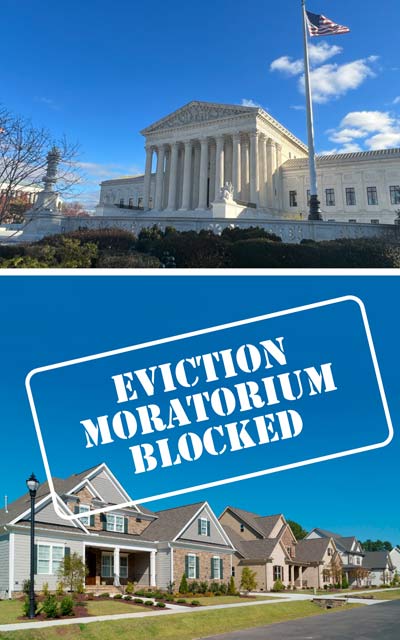
Supreme Court Blocks Biden Administration’s Eviction Moratorium

On August 26, 2021, the United States Supreme Court in a 6-3 ruling, blocked the latest Centers for Disease Control (CDC) Eviction Moratorium, finding that the CDC exceeded its authority. A majority of the Court held that only Congress can allow for such a ban on evictions.

As you may recall, this latest moratorium was imposed on August 3, 2021, by the CDC and was scheduled to expire on October 3, 2021. It prevented residential evictions for the non-payment of rent in counties that had substantial or high transmission levels. After applying the formula provided by the CDC in determining whether a county was experiencing substantial or high transmission levels, it was determined that the moratorium applied to over 90% of the United States.

Now, based on this ruling from the Supreme Court, unless a state has its own eviction moratorium, residential evictions for the non-payment of rent can resume. Currently, Florida and Georgia do not have state-wide moratoriums on residential or commercial tenant evictions.

If you have any questions or concerns about this ruling, its application to mortgage foreclosures, or any other matters related to creditor’s rights, please do not hesitate to reach out to one of the attorneys at Sorenson Van Leuven, PLLC.

New CDC Eviction Moratorium

On August 3, 2021, the Biden Administration and the Centers for Disease Control (CDC) announced that it is imposing a new moratorium on residential evictions for non-payment of rent. This new moratorium is scheduled to last two months and expire on October 3, 2021. Unlike the prior eviction moratorium that was nationwide and expired on July 31, 2021, this new moratorium is limited to counties that are experiencing substantial or high levels of COVID-19. Based upon various news reports, this new moratorium will apply to almost 90% of the U.S. population.

In determining whether a county is experiencing substantial or high transmission levels, the CDC intends to look at the number of new cases reported per 100,000 residents over a seven-day period and the positivity rate of that county. If the number of new cases in a county in the prior seven days, divided by the population of the county, then multiplied by 100,000 is between 50.99 and
99.9 and the percentage of positive tests in the prior seven days, divided by the total number of tests in the prior seven days is between 8% and 9.99%, then that county is experiencing substantial transmission levels and residential properties in that county are subject to this new CDC eviction moratorium. If the number of new cases in a county in the prior seven days, divided by the population of the county, then multiplied by 100,000 is 100 or greater and the percentage of positive tests in the prior seven days, divided by the total number of tests in the prior seven days is greater than 10%, then that county is experiencing high transmission levels and residential properties in that county are subject to this new CDC eviction moratorium.

For a tenant to be protected under this new moratorium, they must not only live in a county that is experiencing substantial or high COVID-19 infection levels, but they must also file a declaration under penalty of perjury setting forth the following:

  1. The tenant has used best efforts to obtain government assistance for housing,
  2. The tenant earned no more than $99,000.00 or $198,000.00 if filing jointly for the tax year 2020 or received a stimulus check,
  3. The tenant is unable to pay rent,
  4. The tenant is using best efforts to make partial rent payments, and
  5. The eviction will make the individual homeless or forced into a close-
    quarters living situation.

Presently, every county in the State of Florida is experiencing either substantial or high transmission levels, so the CDC eviction moratorium will apply in every county in Florida. In the State of Georgia, every county except Lincoln, Quitman, Webster, and Glascock is experiencing substantial or high transmission levels. The counties in which this applies is subject to change, so if you are dealing with an eviction in a particular county, you should check for up-to-date data.

If you have any questions or concerns about the new moratorium, its application to mortgage foreclosures or any other matters related to creditor’s rights, please do not hesitate to reach out to one of the attorneys at Sorenson Van Leuven, PLLC.

CFPB Confirms Effective Date for Debt Collection Rules

Yesterday, the Consumer Financial Protection Bureau (CFPB) announced that the two final rules under the Fair Debt Collection Practices Act will take effect on November 30, 2021. Previously, the CFPB issued a proposal to move the effective date to January 29, 2022, to give third-party debt collectors more time to implement the new rule due to the pandemic. The CFPB has now determined that an extension is unnecessary. While the rule is aimed at third-party debt collection, the rule does have some impact on creditors who work with third-party debt collectors.

Should you have questions about the two final rules or how it impacts your organization, please do not hesitate to contact a lawyer at Sorenson Van Leuven.

Update on New CFPB Rule and CDC Eviction Moratorium

On Monday, June 28, 2021, the Centers for Disease Control and Prevention (CDC) issued final amendments to the Federal mortgage servicing rules. Pursuant to the Consumer Financial Protection Bureau (CFPB), these amendments are designed to facilitate a smooth transition in the housing market and mortgage servicing industry as federal foreclosure protection is scheduled to expire on July 31, 2021.

The amendments take effect on August 31, 2021, and cover loans on principal residences. The changes generally exclude small servicers, so many credit unions will be exempt. These amendments have sunset provisions or expirations, with some expiring on January 1, 2022, and others expiring on October 1, 2022.

The rule will require services to increase their efforts to reach borrowers and work with those borrowers to avoid foreclosure. The rule will allow foreclosures to start if: (1) the borrower has abandoned the property; (2) the borrower was more than 120 days behind on their mortgage before March 1, 2020 (and they are still behind by at least 120 days); (3) the borrower is more than 120 days behind on their mortgage and has not responded to specific required outreach from the mortgage servicer for 90 days; or (4) the borrower has been evaluated for all options other than foreclosure and there are no available options to avoid foreclosure.

For those attending the SVL SourcExpo (July 21st through July 23rd), we will cover these amendments in more detail. Information on the SVL SourcExpo can be found here: https://svllaw.com/sourcexpo-2021/

Additionally, on Tuesday, June 29, 2021, the United States Supreme Court voted 5 to 4 to keep in place the CDC eviction moratorium. That means that legal attempts to stop the eviction moratorium have failed, as the CDC has indicated that it will not extend the moratorium past July 31, 2021.
Should you have questions about the amendments to the mortgage servicing rules or the CDC eviction moratorium, please reach out to a lawyer at SVL.

Extension of Fannie Mae Single-Family Foreclosure Moratorium

The Federal Housing Finance Administration (FHFA), an independent federal agency that oversees Fannie Mae and Freddie Mac, has announced that it is extending its moratorium on residential mortgage foreclosures through July 31, 2021. This moratorium was scheduled to expire on June 30, 2021. This applies to all residential mortgage loans that are owned by Fannie Mae and Freddie Mac, and prevents any servicer from seeking to file a foreclosure or complete a foreclosure on any residential property that is occupied.

In addition, the Biden Administration has extended its moratorium on foreclosures for federally backed mortgages (loans insured by HUD, VA and USDA) through July 31, 2021. The moratorium on federally backed loans, which has been in place since March 2020 and extended on several occasions, was also scheduled to expire on June 30, 2021.

Lastly, the Centers for Decease Control (CDC) announced that it has extended its nationwide moratorium on residential tenant evictions through July 31, 2021. Much like the foreclosure moratoriums on federally backed loans, the moratorium on evictions was scheduled to expire on June 30, 2021. In announcing this extension, the CDC has also stated that this will be the last extension of its moratorium.

If you have any questions or concerns about these moratoriums, or any other matters related to creditor’s rights, please do not hesitate to reach out to one of the attorneys at Sorenson Van Leuven, PLLC.